'/%3E%3C/svg%3E)

'/%3E%3Cpath%20fill='%23b2b2b2'%20d='M241%20382q0%2016%2017%2026%2017%2011%2042%2011t42-11q16-11%2017-26V269H241'/%3E%3Cpath%20fill='%239f7e00'%20d='M241%20379q0%2014%208%2023%209%209%2021%209%2014%200%2021-9%209-9%209-23V269h-59'/%3E%3Cpath%20d='M241%20339v-70h59v110q0%2014-9%2023l-6%205v-68h-15v72q-8%200-14-4v-68zm59%2040c0%2022%2015%2032%2029%2032%2021%200%2030-18%2030-32v-40h-59'/%3E%3Cpath%20fill='%239f7e00'%20d='M266%20277v5h2v12h-3v-5h2v-5h-9v5h2v5h-4v9h3v18h-5v10h34v-10h-5v-18h3v-9h-4v-5h2v-5h-9v5h2v5h-3v-12h2v-5zm42%20101q0%2010%206%2017%206%206%2015%207%2010-1%2016-7%206-7%206-17v-29h-43'/%3E%3Ccircle%20fill='%230044ad'%20cx='329.5'%20cy='372'%20r='6'/%3E%3Cellipse%20fill='%230044ad'%20cx='300'%20cy='340'%20rx='16'%20ry='21'/%3E%3C/svg%3E)


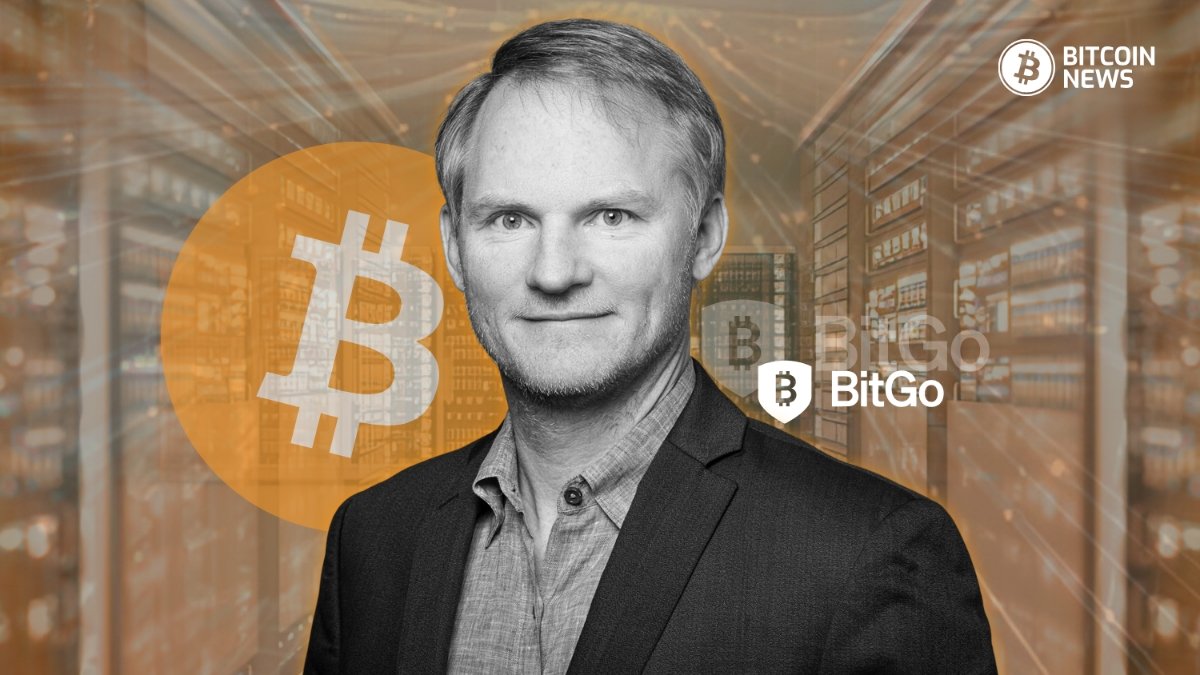


Most people dismiss Bitcoin two or three times before they get it. Mike Belshe, CEO and co-founder of BitGo, was no different. The computer scientist and inventor of HTTP/2.0 and one of the first ten engineers on Google Chrome initially thought Bitcoin was “probably a scam.”
That was before he tried to hack it.
“I went and tried to hack it,” Belshe recalls. “That just led me down figuring out how it worked, etc. And of course, I couldn’t hack it. I was like, ‘Holy cow, this might actually be money that works.’”
That moment of realization launched a journey that would transform Belshe from a web performance engineer into one of Bitcoin’s most important infrastructure builders.
Today, BitGo processes transactions for nearly 4,000 institutions and has become what Belshe calls “the AWS of digital assets.”
The Laptop Under the Couch Era
Before hardware wallets existed, bitcoin custody was genuinely primitive.
Belshe’s early storage solution was quite innovative. “I had a laptop which I disabled networking in. I stored it securely underneath my couch. I literally had backup keys printed on a piece of paper in the laundry room.”
This wasn’t just for his own bitcoin. As the “technology guy” among his friends, Belshe was storing bitcoin for others too.
When the price started climbing, he realized there had to be a better way. The answer came from an obscure corner of the Bitcoin protocol called P2SH, which Gavin Andresen had controversially pushed forward about a year earlier.
“I wrote to the Bitcoin Wizards group, which was the IRC channel back then,” Belshe explains. “It was such a nice community back then…so different from Bitcoin Twitter today. Everybody was helpful to each other.”
The response was encouraging enough to convince Belshe to spend the summer of 2013 coding what would become one of the first multi-signature wallets.
“I was doing the front end, the back end,” he remembers. “It was a lot of coding and then finally around August of 2013, I launched the first multi-signature capable web hybrid wallet.”
JavaScript and Security Trade-Offs
That early wallet faced immediate skepticism for using JavaScript, which many considered unsafe for cryptographic operations. Belshe’s background working on Chrome gave him unique insights into browser security.
Browsers have been hacked over and over and over again. Chrome focused on this with process isolation and things like that.
JavaScript itself presented additional challenges: “It’s an easily morphable language. One can insert any code into JavaScript, and low-level functions and the way they work can kind of be changed.”
BitGo’s solution was a hybrid approach that generated keys in the browser but also allowed users to bring their own keys generated elsewhere. This flexibility would prove crucial as the company evolved from a wallet service into an enterprise infrastructure.
The Accidental Path to Custody
BitGo’s transformation into a custodian wasn’t planned. “We didn’t really think that far ahead,” Belshe admits. “Instead, what happened was very much a founder’s journey to determine whether there was interest in our product, and how to evolve from there.”
The turning point came in 2016 with CME Group’s Royal Mint Gold project.
CME wanted BitGo’s technology but needed a custodian to hold the keys. “CME really didn’t want to hold keys. They wanted a custodian. At that time, we weren’t a custodian. We couldn’t do it. They looked around and realized that nobody else would do it either.”
This forced BitGo’s hand. Traditional financial institutions weren’t adopting their APIs as expected.
“This is money. It moves way slower than other types of technology adoptions,” Belshe reflects. “To this day, there’s barely any traditional finance infrastructure for digital assets. So early on, we sought to change that.”
The Human Nature of Money
Being a technologist building infrastructure for a pioneering new asset class, Belshe has a pragmatic view of self-custody.
He often poses a thought experiment:
“If you had no bank, if you had no ability to deposit somewhere else and you just had to hold cash, how would you secure it? Would you store it in your house? Would you put bars on your windows? Would you hire a security guy with a gun?”
The answers vary dramatically. Some people are comfortable self-custodying 99% of their net worth; others draw the line at a much smaller percentage.
This human element becomes even more critical in business contexts: “Businesses generally have a fiduciary duty to their shareholders. You can’t just give a billion dollars to the IT guy. No offense to IT teams!”
Building Better Infrastructure
BitGo’s custody approach reflects lessons learned from market history.
Rather than simply criticizing other models, Belshe focuses on what his company does differently: providing fiduciary-protected accounts for all clients, from retail to institutional.
“We’ve got the largest institutional base in the industry, with nearly 4,000 institutions leveraging BitGo’s platform in one way or another.”
This infrastructure focus means BitGo can serve multiple market participants without picking sides.
“We are focused on scaling the entire digital asset industry and onboarding as many institutions and investors as possible. This is a growth space and we recognize it will take time to get to where we want to be. In fact, I’d estimate that 90% of BitGo’s client base in the year 2030 haven’t even touched digital assets yet.”
The AWS of Digital Assets
Belshe sees BitGo positioned similarly to how Amazon emerged from the dot-com era. “We believe BitGo is the Amazon of digital assets. Back in the dot-com era, there were all these jokes about crazy companies that people thought didn’t even deserve to exist.” He added:
“The current digital asset landscape mirrors that innovation cycle. A bunch of these companies are going to shake out and die. And then a few critical components – the Amazons and BitGos of the world – will remain.”
BitGo’s infrastructure-first approach positions it to benefit regardless of which specific blockchains succeed: “Our emphasis is on bringing new customers in and meeting them where they are.”
A Question for Satoshi
When asked what he’d ask Bitcoin’s creator, Belshe focuses on a technical detail that has shaped Bitcoin’s development:
“I might ask him if he had anticipated mining pools. I think he didn’t anticipate that the mining would become as centralized as it has and mining pools helped enable that from the early days.”
This isn’t necessarily criticism. “I’m not complaining about it,” Belshe clarifies.
“I think you look at decentralization across a number of different axes, but I do wish that mining could be much more massively distributed than it is.”
The concern reflects Belshe’s broader perspective on Bitcoin’s evolution. From someone who helped build the faster, more secure web through HTTP/2.0, he understands that technical systems rarely develop exactly as their creators envision.
Building for the Long Term
As Bitcoin matures and institutions flood in, Belshe remains focused on infrastructure.
BitGo now operates seven regulated custodians globally, connects to hundreds of exchanges through smart order routing, and offers everything from self-custody wallets to qualified custody to staking services.
“Our mission is to accelerate the movement of traditional finance into digital assets,” he explains.
“Of course all assets are going to be digital. We’ve been saying this for the better part of the past 10 years now. And a while ago that was kind of a crazy bold idea. These days, don’t ask me, ask Larry Fink. He says every asset, every fund, every bond is going to be tokenized.”
From a laptop under a couch to processing 20% of Bitcoin’s transactions by value at one point, Mike Belshe’s journey building BitGo mirrors Bitcoin’s own evolution from cypherpunk experiment to institutional infrastructure.
As the space continues maturing, BitGo’s bet on being the reliable foundation layer may prove as prescient as Belshe’s early decision to stop trying to hack Bitcoin and start building on it instead.
