'/%3E%3C/svg%3E)

'/%3E%3Cpath%20fill='%23b2b2b2'%20d='M241%20382q0%2016%2017%2026%2017%2011%2042%2011t42-11q16-11%2017-26V269H241'/%3E%3Cpath%20fill='%239f7e00'%20d='M241%20379q0%2014%208%2023%209%209%2021%209%2014%200%2021-9%209-9%209-23V269h-59'/%3E%3Cpath%20d='M241%20339v-70h59v110q0%2014-9%2023l-6%205v-68h-15v72q-8%200-14-4v-68zm59%2040c0%2022%2015%2032%2029%2032%2021%200%2030-18%2030-32v-40h-59'/%3E%3Cpath%20fill='%239f7e00'%20d='M266%20277v5h2v12h-3v-5h2v-5h-9v5h2v5h-4v9h3v18h-5v10h34v-10h-5v-18h3v-9h-4v-5h2v-5h-9v5h2v5h-3v-12h2v-5zm42%20101q0%2010%206%2017%206%206%2015%207%2010-1%2016-7%206-7%206-17v-29h-43'/%3E%3Ccircle%20fill='%230044ad'%20cx='329.5'%20cy='372'%20r='6'/%3E%3Cellipse%20fill='%230044ad'%20cx='300'%20cy='340'%20rx='16'%20ry='21'/%3E%3C/svg%3E)


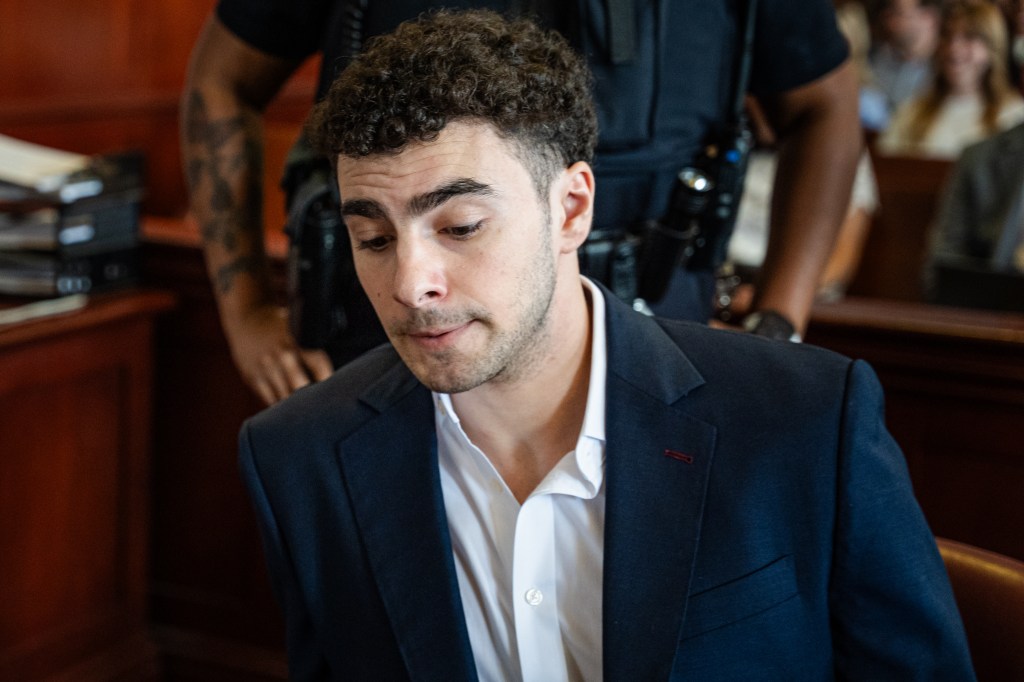


Lawyers for Luigi Mangione on Thursday withdrew a notice regarding an affirmative psychiatric defense in his state homicide case, a day after a Manhattan judge ordered them to share his mental health records with the prosecution.
In a brief letter to the court, Mangione’s lawyer Karen Friedman Agnifilo said his team was withdrawing the paperwork.
Mangione is headed to trial in the case on Sept. 8, charged with second-degree murder and related offenses, alleging he fatally gunned down UnitedHealthcare CEO Brian Thompson on Dec. 4, 2024, as the high-level exec arrived at the Hilton hotel in Midtown to set up for a conference.
At a hearing Wednesday, Manhattan Justice Gregory Carro revealed that the Maryland man was exploring an “extreme emotional disturbance” defense. Thus, he ordered Mangione’s lawyers to immediately provide the district attorney with details of the defendant’s alleged condition and the psych expert they planned to call, so prosecutors could adequately prepare their case. Instead, they withdrew their related notice.
Were they to use the affirmative defense, Mangione’s lawyers would argue at trial that he should not be held criminally responsible for Thompson’s murder since Mangione was under the influence of an extreme emotional disturbance when he shot the victim dead in the street. Were the legal gambit to prevail, Mangione could get off with a conviction of first-degree manslaughter and a significantly lighter prison term.
Defense attorney Ron Kuby on Thursday told the Daily News that Mangione’s lawyers’ withdrawal of the notice barred them from presenting psychiatric evidence, but not from using the prosecution’s evidence to make the case.
Kuby, who has successfully represented several defendants who asserted the extreme emotional disturbance defense, recalled the 2014 homicide case against Gigi Jordan over the killing of her 8-year-old son.
PENINSULA
Jefferson Siegel/New York Daily News Gigi Jordan was convicted of manslaughter for killing her 8-year-old autistic son in a hotel room in February 2010. (Jefferson Siegel/New York Daily News)
Jordan provided extensive testimony about her mental state at the time of the incident, telling the jury she believed her ex-husband intended to murder her and that she was terrified her death would leave the boy in the care of his biological father, who abused him. Her team otherwise relied on the district attorney’s evidence to establish that she was emotionally disturbed during the incident, and convinced a jury to convict her on a manslaughter charge reduced from murder.
Taking the same tack could increase the likelihood that Mangione testifies.
“It absolutely made the difference in Gigi’s case,” Kuby said, adding that her testimony and the DA’s evidence were ultimately all the defense needed.
“Prosecutors put on enough evidence in proving guilt that the jury was left with a profound sense that this woman was profoundly disturbed.”
Jordan died by suicide in 2022.
The extreme emotional disturbance defense differs significantly from the so-called insanity defense, which requires a defendant to prove that, due to a deep-rooted mental disease or defect, they either didn’t understand the nature and consequences of their actions or that what they were doing was wrong.
The former does not require a psychiatric diagnosis or mental health condition, only for the accused to prove they were acting under an extreme emotional disturbance that was reasonable as they understood things.
Among other evidence, prosecutors have alleged that Mangione documented, in extensive written notes, a troubling obsession with corruption in the U.S. health insurance industry and its unaffordability.
The News sought comment from Mangione’s legal team. The Manhattan DA’s office declined to comment.
