




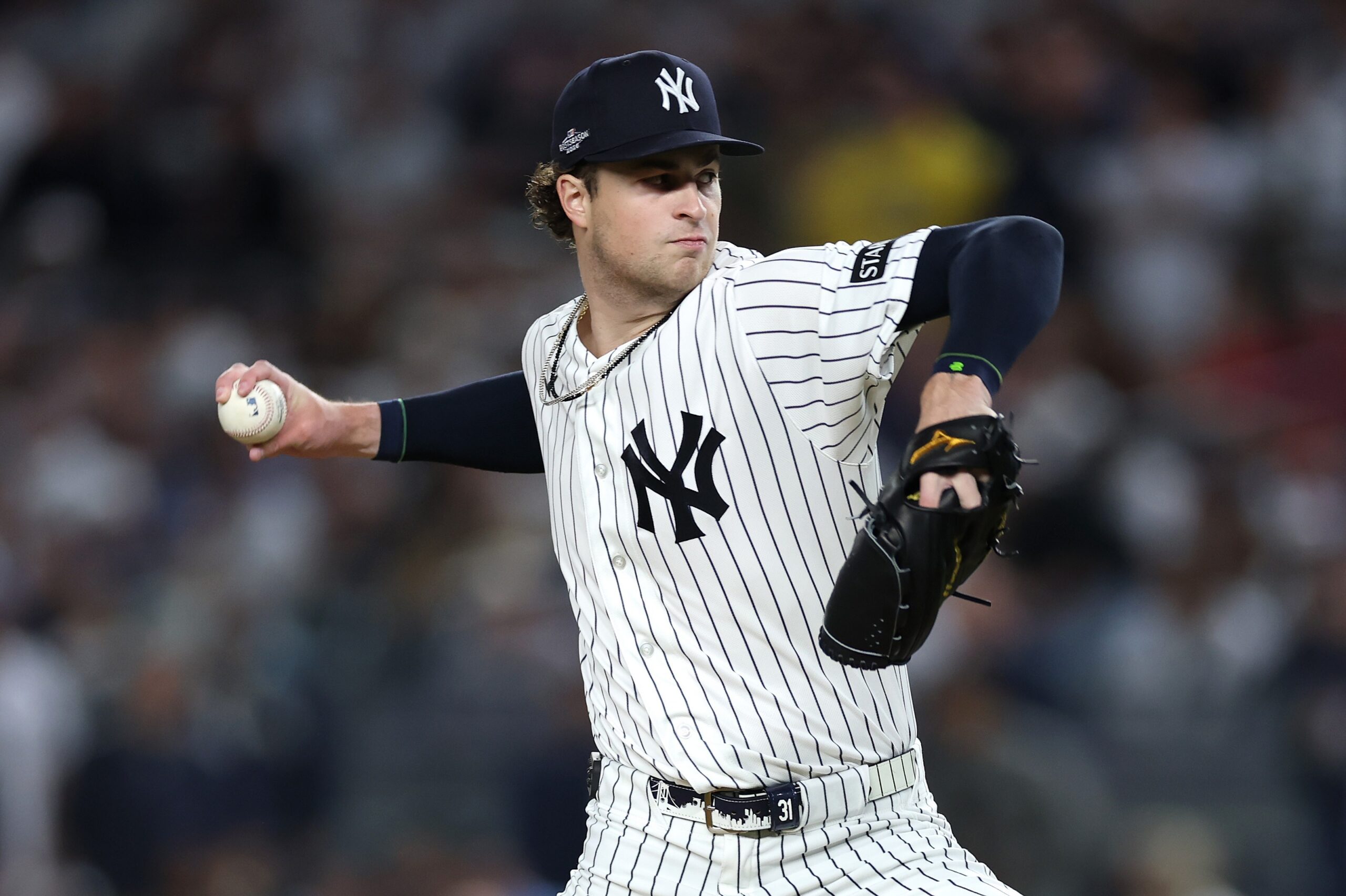


ST. PETERSBURG, Fla. — Cam Schlittler is a lot of things on the mound.
A bulldog. A flamethrower. An ace.
But unpredictable? That typically doesn’t describe a pitcher who threw some version of a fastball just under 90% of the time during the regular season. So when Schlittler spun his curveball at a 27% clip in Game 1 of the Wild Card Series, the Red Sox were understandably surprised.
Of the career-high 117 pitches the Yankees’ right-hander threw, 32 were deuces. The Red Sox swung at the pitch 16 times; they missed on eight of them as Schlittler totaled two hits, one walk and 10 strikeouts over 6.1 innings in a 9-0 win.
Afterward, Aaron Boone said Schlittler had “probably his best curveball of the year.” Meanwhile, Boston manager Chad Tracy noted the “increased usage,” as Schlittler had previously thrown a total of 41 curves in five starts vs. the Red Sox.
“His stuff was good regardless, but you’re right,” Tracy said when asked if Schlittler’s curveball caught Boston off guard. “He was not just using it more, but he was using it very effectively. When you’re dealing with a guy like that with the fastball shapes, you’re looking to get on heaters, and you know he can move it in different directions.”
Now Schlittler is set to face the Rays in Game 2 of the ALDS. His Yankees, fresh off a brutal 1-0 loss in Saturday’s series-opener, desperately need another stellar postseason start from the impending Cy Young, as well as some offense.
“We’re obviously always thrilled when we hand the ball to Cam,” Boone said after Game 1. “Hopefully we can go out and put some points on the board to support him and come out of here with a split and head back home.”
While the Yankees are in search of a split in Tampa, it remains to be seen if the Rays, who had the lowest OPS against curves this year, should be looking for Schlittler’s breaking ball again.
He only threw the pitch 22 times while holding Tampa to five earned runs with 21 strikeouts over 16 innings and three starts during the regular season. However, in Schlittler’s most recent matchup with the Rays on Sept. 24, he tossed 10 curves over just three innings and got three whiffs on six swings.
His other battles with Tampa predated a start against the White Sox on July 29. That day proved pivotal for the development of Schlittler’s curveball, as he used it 19 times while striking out eight over 6.1 innings of one-run ball. The offering yielded seven whiffs and averaged 88.4 mph, a 2.1-mph spike in velocity from its season average.
“I feel like the movement on that pitch and the execution of that pitch and the location have been really good since then,” Schlittler said.
More velocity has been key to Schlittler’s curve becoming a true weapon. Shortly after that Chicago start, Schlittler and Yankees pitching coach Matt Blake said that the hurler had been wanting to add some zip to the pitch, so he simply started throwing it with more intensity.
“Some guys say, ‘Oh, I want to throw a pitch harder,’ and you’re like, ‘All right, that sounds good, but how are you gonna do that?’” Blake said. “And he actually just started throwing it harder.”
Schlittler added that he hasn’t made any changes to his curveball grip since the offseason.
Blake also said that Schlittler’s start against the Tigers on June 30 served as a wake-up call that his arsenal, reliant on four-seamers, cutters and sinkers, required an alternative look. Schlittler surrendered a career-high four home runs to Detroit in his worst start of the season. Each came on a fastball variant.
“Those are all really good pitches,” Blake said, “but when teams are selling out to hit it, you’ve gotta be able to change gears, and that’s ultimately what he’s taken away from that.”
Blake believes that Schlittler’s curveball grades out as “his best pitch from just a pure stuff standpoint.” While public metrics don’t fully support that, his curveball’s Stuff+ grade of 110 matches his sinker and is better than his cutter (107). Schlittler’s four-seamer (120) is his best pitch.
But Schlittler had to learn how to execute his curve better. Improving command of it became an in-season project, as did understanding when to best use it.
If that Wild Card start against Boston is any indication, he seems to have figured all that out.
“[With] the amount of miss and weak contact I’m getting with that,” Schlittler said, “I feel like I’m in a really good spot with it.”
