




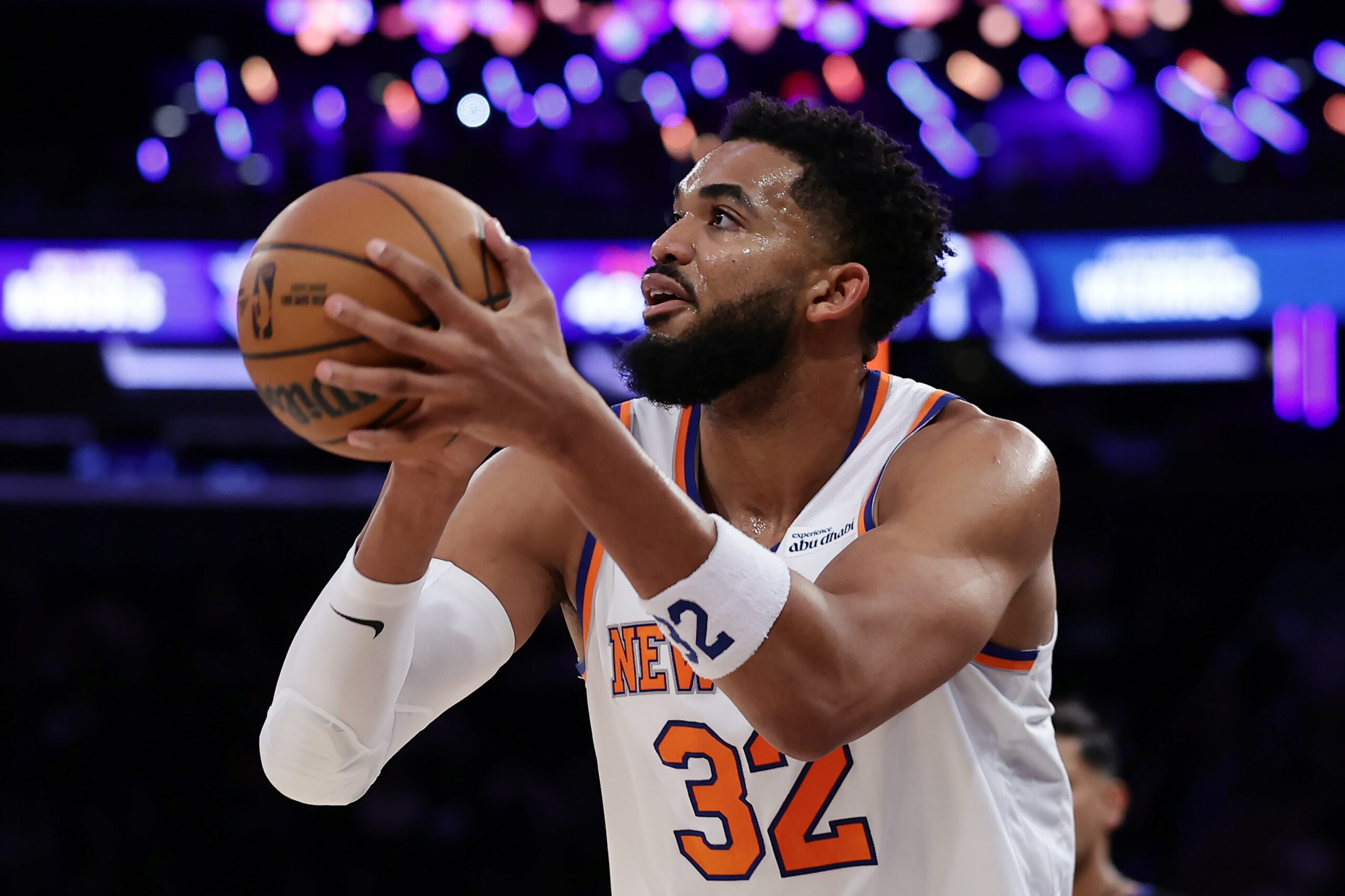


There will be no contract extensions at Madison Square Garden. At least not to start the 2026-27 NBA season.
With Karl-Anthony Towns, Josh Hart and Miles McBride up for new deals following the Knicks’ 2026 NBA championship run, key members from last year’s title team walked into this season expecting to re-up on their pre-existing contracts.
James Dolan’s Knicks are saying not-so-fast: The organization put out a statement Friday saying extension conversations will be tabled until later in the season so the team can prioritize a strong start to the 2027 campaign.
“As an organization, our entire focus is on preparing for the upcoming season and delivering another year for our fans to be proud of,” the team announced Friday. “As a result, we will not be negotiating contract extensions until later in the season and will remain solely focused on preparing for the start of the season.”
The statement comes as the Knicks face an impasse with three key rotation members.
Towns is entering the third year of his four-year, $220 million contract and has a $61 million player option on the final year of that deal, essentially making this upcoming season a contract year: He can decline the player option to test true unrestricted free agency next summer.
Hart is eligible for a four-year, $132 million extension. Like Towns, he has two years left on his contract. Unlike Towns, the Knicks hold a team option on the fourth year of his deal, so they control his option year, in which Hart is due $22 million.
And McBride stands to gain — or lose — the most of the three: He is on the final year of a three-year, $13 million deal. He is due a significant pay raise, anywhere in the $15-20 million range, but would need to take less for the Knicks to stay under the second apron. Hart said the uncertainty could impact on-court performance leading into the early-February NBA trade deadline, and Towns has been outspoken regarding the offer on the table from the Knicks.
“It don’t look good,” he said ahead of tipoff in Philadelphia against the 76ers on Monday.
The Knicks have offered Towns a four-year, $200 million extension, but he views the offer as “unreasonable,” according to ESPN, and told reporters in Philadelphia he expected to be paid well after helping deliver the franchise its first title in 53 years.
Hart said on Media Day he hoped to reach an extension agreement before the regular season, and that without one, the notion of a trade would be floating until the early-February deadline.
McBride expressed disappointment in his contract situation exclusively to the Daily News. He stands to lose every dollar Towns takes given they are both taking from the same salary pie.
The Knicks are in this contract standoff in large part due to the second apron, a recent addition to the NBA’s collective bargaining agreement that penalizes teams whose payrolls exceed the threshold sitting roughly 34.5% above the salary cap. Entering the regular season, the Knicks have room for one minimum salary slot beneath the $222 million second apron. And they are already up against the second apron for next season using modest calculations for contract extensions across the board.
Teams who cross the second apron lose access to their mid-level exception, the ability to combine salaries in trades, have their first-round draft pick seven years out frozen and receive the league’s steepest tax bill.
Stephen A. Smith floated on Tuesday’s episode of ESPN’s “First Take” that the Knicks have also not reached contract extension agreements with team president Leon Rose and vice president William “Worldwide Wes” Wesley, the leaders of the front office responsible for constructing the championship roster.
