'/%3E%3C/svg%3E)

'/%3E%3Cpath%20fill='%23b2b2b2'%20d='M241%20382q0%2016%2017%2026%2017%2011%2042%2011t42-11q16-11%2017-26V269H241'/%3E%3Cpath%20fill='%239f7e00'%20d='M241%20379q0%2014%208%2023%209%209%2021%209%2014%200%2021-9%209-9%209-23V269h-59'/%3E%3Cpath%20d='M241%20339v-70h59v110q0%2014-9%2023l-6%205v-68h-15v72q-8%200-14-4v-68zm59%2040c0%2022%2015%2032%2029%2032%2021%200%2030-18%2030-32v-40h-59'/%3E%3Cpath%20fill='%239f7e00'%20d='M266%20277v5h2v12h-3v-5h2v-5h-9v5h2v5h-4v9h3v18h-5v10h34v-10h-5v-18h3v-9h-4v-5h2v-5h-9v5h2v5h-3v-12h2v-5zm42%20101q0%2010%206%2017%206%206%2015%207%2010-1%2016-7%206-7%206-17v-29h-43'/%3E%3Ccircle%20fill='%230044ad'%20cx='329.5'%20cy='372'%20r='6'/%3E%3Cellipse%20fill='%230044ad'%20cx='300'%20cy='340'%20rx='16'%20ry='21'/%3E%3C/svg%3E)




CNN
—
After decades of threats, Israel on Friday launched an audacious attack on Iran, targeting its nuclear sites, scientists and military leaders.
Israeli Prime Minister Benjamin Netanyahu said the operation had “struck at the head of Iran’s nuclear weaponization program.”
But international assessments, including by the US intelligence community, say that Iran’s nuclear program isn’t currently weaponized. Tehran has also repeatedly insisted it isn’t building a bomb.
Still, that doesn’t mean it couldn’t if it chose to.
Iran has spent decades developing its nuclear program and sees it as a source of national pride and sovereignty. It maintains the program is solely for peaceful energy purposes and plans to build additional nuclear power plants to meet domestic energy needs and free up more oil for export.
Nuclear plants require a fuel called uranium – and according to the UN nuclear watchdog, no other country has the kind of uranium that Iran currently does without also having a nuclear weapons program.
That has fueled suspicions that Iran isn’t being fully transparent about its intentions. Tehran has used its stockpile of weapons-grade uranium as a bargaining chip in talks with the United States, repeatedly saying it would get rid of it if US-led sanctions are lifted.
So, what exactly is uranium’s role in a nuclear weapon, and how far is Iran from weaponizing its program? Here’s what you need to know.
The US launched a nuclear program with Iran in 1957. Back then, the Western-friendly monarch – the Shah – ruled Iran and the two countries were still friends.
With backing from the US, Iran started developing its nuclear power program in the 1970s. But the US pulled its support when the Shah was overthrown during the Islamic Revolution in 1979.
Since the revolution, which transformed Iran into an Islamic Republic, Western nations have worried the country could use its nuclear program to produce atomic weapons using highly enriched uranium.
Iran has maintained that it does not seek to build nuclear weapons. It is a party to the UN’s Nuclear Non-Proliferation Treaty (NPT), under which it has pledged not to develop a bomb.
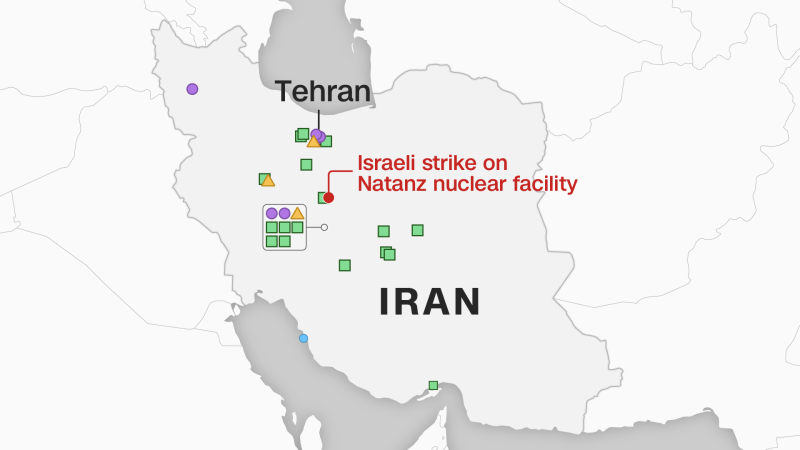
Here’s where its nuclear facilities are located.
At the heart of the controversy over Iran’s nuclear program is its enrichment of uranium – a process used to produce fuel for power plants that, at higher levels, can also be used to make a nuclear bomb.
In the early 2000s, international inspectors announced that they had found traces of highly enriched uranium at an Iranian plant in Natanz. Iran temporarily halted enrichment, but resumed it in 2006, insisting it was allowed under its agreement with the UN’s nuclear watchdog, the International Atomic Energy Agency (IAEA).
It prompted years of international sanctions against Iran.
After years of negotiations, Iran and six world powers in 2015 agreed to a nuclear deal that limited Iran’s nuclear threat in return for lighter sanctions.
The deal required Iran to keep its uranium enrichment levels at no more than 3.67%, down from near 20%, dramatically reduce its uranium stockpile, and phase out its centrifuges, among other measures.
Uranium isn’t bomb-grade until it’s enriched to 90% purity. And nuclear power plants that generate electricity use uranium that is enriched to between 3.5% and 5%.
It’s unclear how close Iran might be to actually building a nuclear bomb, if at all, but it has made significant progress in producing its key ingredient: highly enriched uranium. In recent years, it has sharply reduced the time needed to reach weapons-grade levels – now requiring just about a week to produce enough for one bomb.
In 2018, Trump pulled out of the Iran nuclear deal and initiated new sanctions on the regime to cripple its economy.
Tehran in turn said it would stop complying with parts of the agreement, and started increasing uranium enrichment and uranium stockpiles, and using advanced centrifuges.
It removed all of the IAEA equipment previously installed for surveillance and monitoring activities.
The Biden administration then kicked off more than a year of indirect negotiations with Iran aimed at reviving the deal, but those broke down in 2022.
In 2023, the IAEA said uranium particles enriched to 83.7% purity – close to bomb-grade levels – were found at an Iranian nuclear facility. Its stockpile of uranium enriched up to 60% had also grown to 128.3 kilograms, the highest level then documented.
And last year, the US shortened Iran’s so-called “breakout time” – the amount of time needed to produce enough fissile material for a nuclear weapon – “to one or two weeks.”
An IAEA report sent to member states late last month said Iran’s stock of 60% purity enriched uranium had now grown to 408 kilograms. That is enough, if enriched further, for nine nuclear weapons, according to an IAEA yardstick.
The IAEA has long accused Iran of violating its non-proliferation obligations, but on Thursday – for the first time in almost 20 years – its board passed a resolution officially declaring Iran in breach of those obligations. Iran promised to respond by escalating its nuclear activities.
Enrichment is a process that increases the amount of uranium-235, a special type of uranium used to power nuclear reactors or, in much higher amounts, to make nuclear weapons.
Natural uranium is mostly uranium‑238 – about 99.3%, which isn’t good for power or bombs. Only about 0.7% is uranium‑235, the part needed to release energy.
For nuclear energy use, that tiny amount of useful uranium-235 needs to be concentrated. To do this, uranium is first turned into a gas, then spun at high speeds in machines called centrifuges. These machines help separate uranium-235 from the more common uranium-238. That is what enrichment is.
Uranium used in nuclear power plants is typically enriched to about 3.67%. To make a nuclear bomb, it needs to be enriched to around 90%. Iran has enriched uranium to 60% – not enough for a bomb, but a major step closer to weapons-grade material.
Centrifuges are essential for enriching uranium. The more advanced the centrifuge, the faster and more efficiently it can separate uranium-235 from uranium-238 – shortening the time needed to produce nuclear fuel or, potentially, weapons-grade material. Iran has spent decades improving its centrifuge technology, starting with its first-generation IR-1 model in the late 1980s. Today, it operates thousands of machines, including advanced models like the IR-6 and IR-9.
According to the Arms Control Association, Iran’s current centrifuge capacity could allow it to produce enough weapons-grade uranium for a bomb in less than two weeks.
Israel says it’s targeting Iran’s nuclear infrastructure in its attack.
Natanz, the facility at the heart of Iran’s nuclear ambitions, was engulfed in flames on Friday, according to social media images geolocated by CNN and Iranian state television coverage.
The nuclear complex there, about 250 kilometers (150 miles) south of the capital Tehran, is considered Iran’s largest uranium enrichment facility. Analysts say the site is used to develop and assemble centrifuges for uranium enrichment, a key technology that turns uranium into nuclear fuel.
The IAEA said three nuclear sites, Fordow, Isfahan and Bushehr, had not been impacted.
Six of Iran’s nuclear scientists were also killed in Israel’s strikes, Iranian state-affiliated Tasnim news agency said.
Iran has spent years strengthening its nuclear structures against the threat of military strikes, which will make it difficult to comprehensively destroy them, military experts have told CNN.
Some facilities are buried deep underground to put them out of reach of Israel’s weapons.
