'/%3E%3C/svg%3E)

'/%3E%3Cpath%20fill='%23b2b2b2'%20d='M241%20382q0%2016%2017%2026%2017%2011%2042%2011t42-11q16-11%2017-26V269H241'/%3E%3Cpath%20fill='%239f7e00'%20d='M241%20379q0%2014%208%2023%209%209%2021%209%2014%200%2021-9%209-9%209-23V269h-59'/%3E%3Cpath%20d='M241%20339v-70h59v110q0%2014-9%2023l-6%205v-68h-15v72q-8%200-14-4v-68zm59%2040c0%2022%2015%2032%2029%2032%2021%200%2030-18%2030-32v-40h-59'/%3E%3Cpath%20fill='%239f7e00'%20d='M266%20277v5h2v12h-3v-5h2v-5h-9v5h2v5h-4v9h3v18h-5v10h34v-10h-5v-18h3v-9h-4v-5h2v-5h-9v5h2v5h-3v-12h2v-5zm42%20101q0%2010%206%2017%206%206%2015%207%2010-1%2016-7%206-7%206-17v-29h-43'/%3E%3Ccircle%20fill='%230044ad'%20cx='329.5'%20cy='372'%20r='6'/%3E%3Cellipse%20fill='%230044ad'%20cx='300'%20cy='340'%20rx='16'%20ry='21'/%3E%3C/svg%3E)


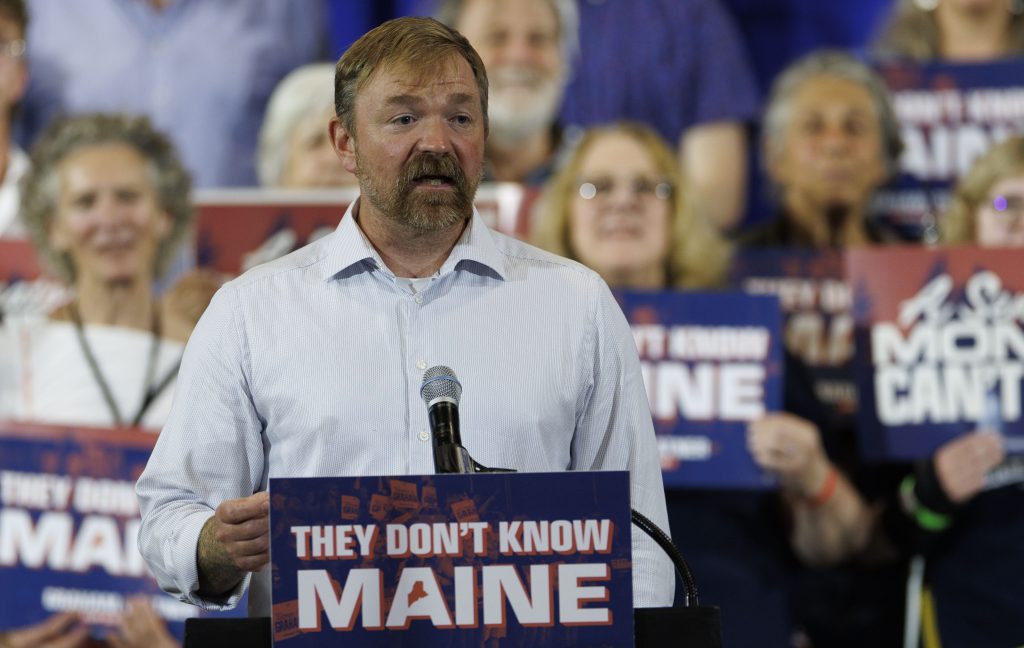


The spectacular implosion of Graham Platner’s high-profile campaign for Maine’s U.S. Senate seat over a sex assault allegation has created a huge headache for Democrats in race that is seen as crucial to their long-shot fight to retake the Senate in the fall midterm elections.
Feuding Maine Democrats are squabbling over who will replace the scandal-tarred Platner and resume the fight to unseat five-term Republican Sen. Susan Collins, a must-win contest in their uphill struggle to flip at least four GOP-held seats and grab back control from President Trump’s allies.
At least a half-dozen candidates have thrown their hats in the ring as party leaders plan what could be a very contentious mini-convention to pick a repacement for Platner on the fall general election ballot.
That confab is expected to be held on July 25, just 48 hours ahead of a July 27 deadline set by Maine law to replace Platner, who Friday filed paperwork to officially withdraw from the race.
Conventional wisdom says Platner’s headline-grabbing fall and the fingerpointing over his candidacy along with fierce factional disputes over a new candidate amount to an enormous setback in Democratic efforts to topple Collins and retake the Senate.

Whoever wins the nomination will need to unite Democrats including both Platner’s legion of loyal supporters and those who believe he used left-wing talking points to distract voters and pundits into looking past his shaky past.
“What a fiasco,” said Larry Sabato, a University of Virginia political scientist. “Democrats have chosen the arrangement I’ve seen often in my life: a circular firing squad.”
“Maine was the easiest pickup for Democrats,” he added. “Not a good start to the general election.”
Some establishment Democrats and analysts also say it’s a warning sign about the danger of letting progressives play too big a role in picking candidates like Platner who may be unvetted and could have damaging personal skeletons in the closet.
“Stop betting on vibe-based candidates with glaring red flags,” said Emily Macklin of Emily’s List, a group that promotes women candidates and had backed Gov. Janet Mills’ losing primary campaign against Platner.
But other Democratic strategists and non-partisan political analysts counter that the pundits are missing a critical point.
They say the opportunity to replace the toxic Platner with a less-controversial pick could actually improve their chances against Collins, who is the only Republican senator representing a state that voted for Democrat Kamala Harris in 2024. That’s especially true because the overall political environment is extremely grim for the GOP, with Trump’s approval ratings far underwater.
“Since Democrats have been over-performing in races across the country, the party can still hope for victory in Maine assuming they can embrace and properly resource a candidate to replace Platner,” said Basil Smikle, a Columbia University professor and Democratic strategist.
Among the likely candidates to replace Platner are Troy Jackson, Maine’s former state Senate president and a onetime close Platner ally; Nirav Shah, a state public health official; and Secretary of State Shenna Bellows, who lost badly to Collins in 2014.
Actor Patrick Dempsey, the hunky “Grey’s Anatomy” star and Maine native, said he’s not interested in a rumored run.
It’s still unclear how the 600 delegates to the convention will be picked or how they will select a nominee, adding to the drama.
Platner, 41, an gravel-voiced combat veteran and oysterman, took the state by storm when he joined the race last year with a message of working class populism. He drove Mills out of the race and cruised to a walkover primary win as voters looked past a shaky past, allegations of bad behavior with women and a Nazi-themed tattoo.
Platner’s support cratered last week when ex-girlfriend Jen Racicot went public with her claim that he drunkenly forced her to have sex after she told him to stop in 2021.
The onetime rising star’s 11-minute video statement appeared to complicate the path forward because he lashed out at the party establishment for torpedoing his campaign, suggesting that he might not be planning to leave the political scene quietly.
According to the statute, party officials may select a new nominee if a candidate who won the primary withdraws by 5 p.m. on July 13, a deadline Platner has now met.
The political stakes are enormous.
Democrats must hold their own seats and flip four GOP-held Senate seats to gain control of the 100-member chamber, which Republicans now hold by a 53-47 margin. Party leaders an analysts have long viewed Maine as a critical piece of the puzzle, because the state leans Democratic, along with swing state North Carolina, where Democratic ex-Gov. Roy Cooper is favored.
Democrats also must hope to defeat GOP candidates in some combination of red states like Alaska, Ohio and Iowa.
Smikle brushed off the fear that Democratic infighting in Maine between progressives who supported Platner and establishment forces could damage Democrats’ chances in other states.
In the Michigan Senate race, for example, Democrats are battling in a fierce primary between Rep. Haley Stevens, a moderate and strong supporter of Israel, and progressive Abdul El-Sayed, a former state lawmaker and losing candidate for governor.
Sabato said the real message isn’t related to ideological schisms, but rather the process of making sure outsider candidates don’t have explosive baggage that may be hidden behind an attractive package like Platner’s.
“What politicos outside Maine have learned is, you must have thorough vetting of your candidates,” he said.
