






ST. PETERSBURG, Fla. — The devil ray may not be a danger to humans, but the Tampa Bay Rays pose a significant threat to the Yankees‘ October hopes.
It wasn’t just Jonathan Aranda‘s third-inning home run that stung the Bombers, or the way Chandler Simpson robbed Luis Garcia Jr. of a leadoff single in the fourth. It wasn’t only the 7.2 no-hit innings thrown by Drew Rasmussen. With the margin for error thin, it was all of that plus one bad decision by Austin Wells that led to a 1-0 loss to Tampa Bay in Game 1 of the ALDS on Saturday night at Tropicana Field.
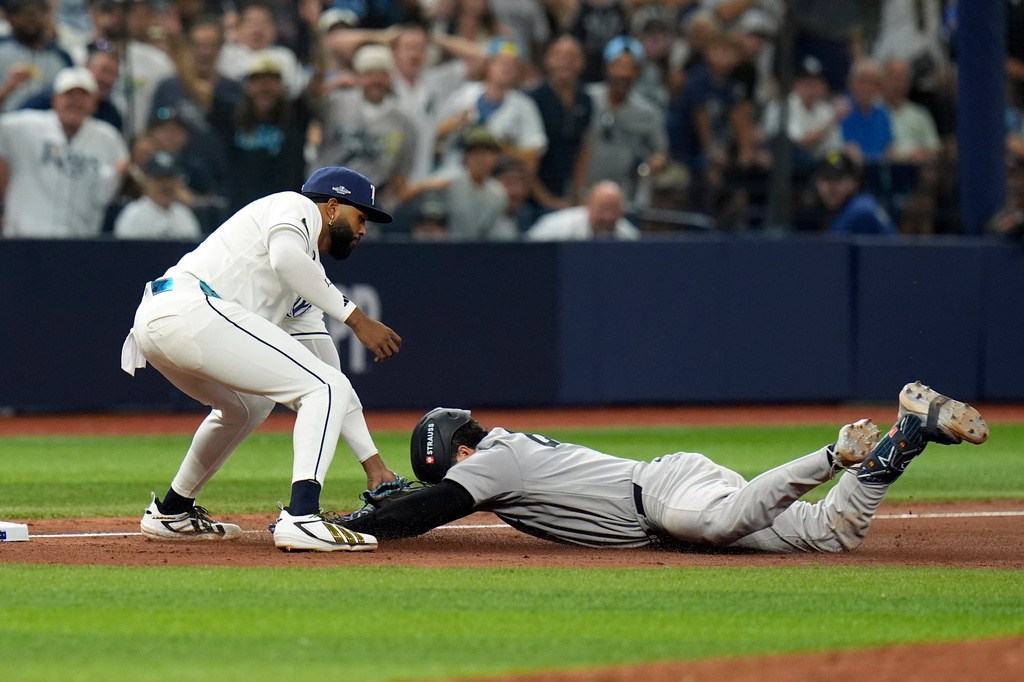
Wells finally broke through with a double to right field, but tried to stretch it into a triple, blowing past the stop sign from third base coach Luis Rojas. The throw came in from right field to the shortstop and from the shortstop to third base with plenty of time. Wells was out, and the inning was over.
“That wins and loses games,” Wells said of risk-taking. “You have to take risks, but in that situation, obviously the risk was wrong. I don’t think I can tell you if I’d do it again because situations are different. Obviously, I took the risk; it didn’t work out. But I think I needed to try to make something happen there.”
His thought process was this: The turf plays fast, he’s far more likely to score on a single if he’s at third, and Mesa would have to make a perfect throw… Which, well, he did.
The Rays can beat you several different ways; it’s death by 1000 cuts until you bleed out and become shark chum in the bay. But in this case, the Yankees beat themselves by being too eager to make something happen.
“There’s mistakes every now and then in aggression,” said manager Aaron Boone. “Obviously, that was one. He’s usually a little more risk-averse on the bases. Obviously, it’s a mistake – it does happen.”
The problem is that the Rays didn’t make any mistakes.
The Yankees want to play a certain way; they want to jump all over a pitch that misses its location or take a base on an errant throw. They want to put the ball in play and make teams pay. But Rasmussen nearly no-hit them and the defense made every play they had to make.
How can the Yankees capitalize on something that isn’t there?
“A mistake there,” Boone said. “But the biggest issue is just Rasmussen shutting us down.”
The key to Rasmussen’s dominance was his efficiency. Of the 101 pitches he threw, 69 were strikes. After taking a lead in the bottom of the third, Rasmussen came back with a nine-pitch inning in the top of the fourth, and needed only 11 to get through the fifth.
He was exceptionally sharp, hitting all of his spots and working quickly. The Yankees were up and down, and back out on defense within what felt like a matter of seconds.
“It’s tough when guys find a rhythm like that,” said Ben Rice, the Yankees’ DH for the night. “When a guy is on, he’s on, but we’ve just got to try and stick with it. Just keep putting together team at-bats.”
There were some good at-bats and quality contact early. George Lombard Jr. hit a ball to the warning track in the second inning, and a ball that died on the warning track in the seventh. For the most part, Rasmussen limited hard contact. In just his second-ever postseason start, Rasmussen struck out 10 and walked two before handing the ball over to closer Bryan Baker for the save.
It was the longest postseason no-hit bid against the Yankees in the modern era (since 1900).
“I thought his changeup was good for him and in play,” Boone said. “Obviously, with our left-handed hitters, it looked like he had the cutter going when he needed to. Then the good four-seamer where he mixed in some sinkers off of it. His command is just really good and kind of what sets him apart.”
The Yankees will likely see the Rays ace again in the best-of-five series.
“The reality is, you want to go deep in the playoffs, you’ve got to beat probably a great pitcher at some point,” Boone said. “So we’ve got to find a way. Hopefully, we’re in a position to get another crack at him and execute a little better.”
In his first postseason start since Game 4 of the World Series, right-hander Gerrit Cole was stellar over five innings, holding the Rays to only one earned run on five hits, walking one and striking out five.
The two AL East foes are obviously familiar with one another, so the Yankees knew it would be tough. They also knew it would be tough without slugger Aaron Judge. Nothing was surprising about the way Tampa Bay played.
About the only surprising aspect of Game 1 was an exceptionally home-heavy sellout crowd. The Yankees were expecting plenty of their own fans in what has always played like their second home, but found themselves being booed by much of the 40,542 fans at the Trop.
Monday, they’ll have to give their fans something to cheer about. Otherwise, they could be underwater by the time they return to New York.
