




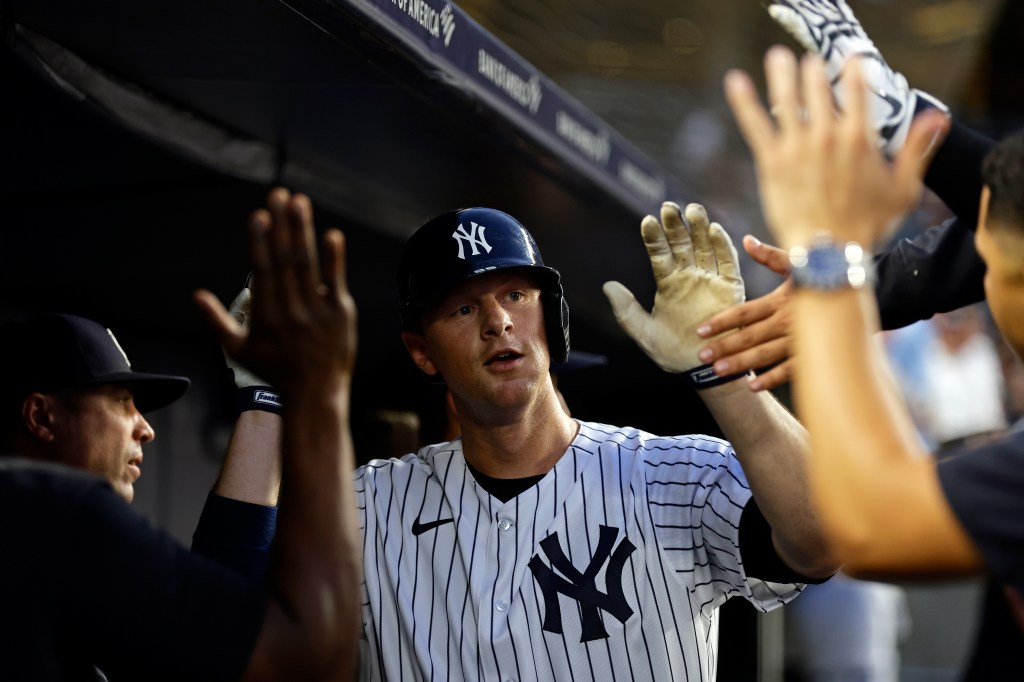


As reporters waited inside the Yankees’ clubhouse following Tuesday’s win over the Mariners, a request was put in for DJ LeMahieu to speak.
Hours earlier, Aaron Boone declared that the two-time batting champ would transition from second base to a bench role, news of which LeMahieu took “not great, necessarily,” the manager said. Naturally, media members wanted to hear it from LeMahieu himself.
Instead, the exceptionally quiet veteran walked past the clubhouse doors in street clothes as he made his way home for the night. For a man of few words, it was a fitting end to his Yankees career.
On Wednesday, the Bombers designated LeMahieu for assignment even though they still owe him approximately $22 million through next season. On Thursday, he was officially released after clearing waivers, to no one’s surprise, making him a free agent.
The moves followed days of difficult conversations with Boone and Brian Cashman, who ultimately decided that the Yankees’ roster flexibility was being compromised by the oft-injured LeMahieu’s vanished versatility.
Signed to be an “everyday utility guy” in 2019, as Cashman put it, LeMahieu initially inked a two-year, $24 million contract with the Yankees after earning two All-Star nods, three Gold Gloves and a batting title over seven seasons with the Rockies.
The pact turned out to be a bargain, as LeMahieu set career-highs with 26 home runs and 102 RBI while hitting .327 as a first-year Yankee. He finished fourth in MVP voting.
Then he finished third for the award in 2020, ending the pandemic-shortened season with another batting title. On top of that, LeMahieu manned second, third and first and hit .306 with three homers and 11 RBI in the playoffs over his first two seasons with the Yankees.
The club rewarded him with a six-year, $90 million contract.
Cashman could have re-signed LeMahieu for fewer years and a higher average annual salary, but the Yankees wanted to spread the money out over more seasons for luxury tax purposes. With the Yankees dismissing LeMahieu on Wednesday and still on the hook for a ton of money, Cashman said he doesn’t regret the structure.
“Sometimes these things work out in your favor,” the general manager said. “Sometimes they don’t.”
LeMahieu just hasn’t been the same player since signing that second deal, as he has a 99 wRC+ dating back to the start of the 2021 season. That ranks 20th-worst among players with at least 2,000 plate appearances over that span.
Jan. 16, 2021: It’s a hit!
New York Daily News Jan. 16, 2021: DJ, Yankees make sweet music on 6-year deal worth $90 million, giving Bomber their key slugger and roster flexibility. DJ LeMahieu said he wanted to stay with Yankees, and on Friday he gets his big payday with huge deal that is also team friendly.
Last year, LeMahieu endured the worst season of his career, posting a 53 wRC+. He had a mark of 95 this season and was actually producing a bit when the Yankees cut ties, but his lack of mobility at second and preference to stay away from third, where Jazz Chisholm Jr. had struggled defensively, relegated him to a bench spot and no clear lane for a defined role.
LeMahieu’s decline has coincided with numerous injuries. He hasn’t played in a single playoff game since signing his second deal with the Yankees.
In 2021, LeMahieu missed the postseason with a right sports hernia and underwent core muscle repair surgery in the offseason. In 2022, he suffered a broken sesamoid bone in his right big toe, which led to ligament damage in his second toe, an awful second half, another postseason absence and a subpar 2023 campaign. In 2024, he broke his right foot with a foul ball in spring training and ended the season with a hip impingement.
During camp this year, LeMahieu said that he had “lost a lot of sleep” over all the time he’s missed, but he was eager to prove doubters wrong with a clean bill of health. Then he sustained a calf strain in his first spring training game, and he later received a cortisone shot for his hip while rehabbing.
“It’s tough to be a guy that the team can’t rely on at times,” LeMahieu said in February. “I always take pride in that, so to not be able to do that, it’s definitely frustrating. But at the same time, I haven’t lost my passion for helping this team and my passion for this team. So that keeps me going.”
While LeMahieu’s passion remained, his award-winning bat did not. Neither did his defensive prowess and versatility.
Over the winter, the four-time Gold Glover told the Yankees that he felt most comfortable at second base. Still, they were “hopeful” that he could be an option at third base. That changed after the calf injury.
While Boone said that LeMahieu was willing to work to make third base a possibility again before his release, the position had become too physically “demanding” for him.
“I know he strongly felt that the best way for him moving forward was to try to solely stay on the right side of the infield,” Cashman said, but second had also become too much, as LeMahieu displayed diminished range over 45 games.
Cashman suggested that LeMahieu’s injuries, particularly the hip issues, are what steered him away from the hot corner.
Unneeded at first, the Yankees sent LeMahieu packing, though not without some appreciation for the good times.
With a once prolific bat, a willingness to play anywhere in his prime, and a reserved, lead by example demeanor, Boone called LeMahieu “as widely respected a player as we’ve had.”
“He’s earned that with just his professionalism, his toughness, his play on the field, just kind of the quiet way he goes about things,” Boone said. “There’s a lot of guys that have an immense amount of respect for DJ.”
Cashman agreed, but that wasn’t going to stop years of aches and pains from catching up to an aging LeMahieu.
“He’s a great player, a great person,” Cashman said. “He’s done great things here. Obviously, the last few years have not been what he or we had hoped for, but that’s also part of the game.
“Those injuries can change the dynamic and the equation altogether.”
