




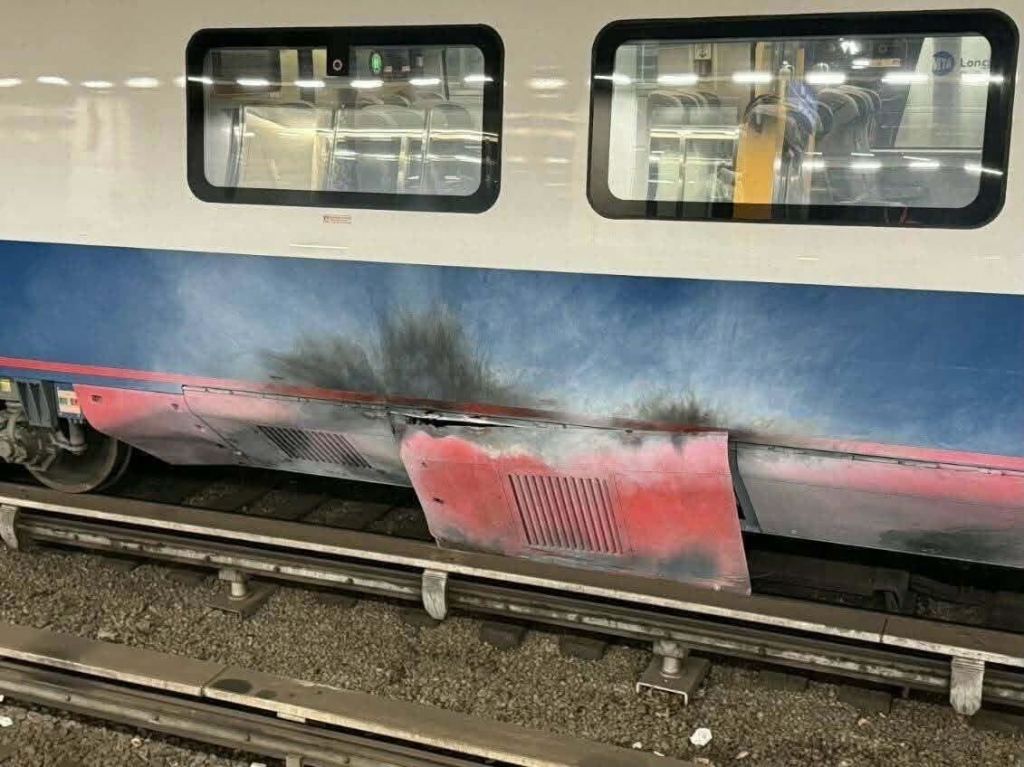


The electrical fire that knocked out LIRR and NJ Transit service to New York Penn Station on Thursday was likely caused when a loose panel on an Amtrak Acela train made contact with the third rail just inside the East River Tunnel, the Daily News has learned.
The panel, which came loose from the side of the second car of Amtrak train No. 2155 on Thursday morning, appears to have shorted out the signaling system near a rail switch governing tracks 3 and 4 of the East River Tunnel, according to a source with knowledge of the incident.
A photo of the train, obtained by the Daily News, shows a passenger rail car painted in the colors of Amtrak’s newest Acela fleet, empty and sitting on the tracks. A red metal panel, hanging off the side of the train, can be seen grazing the third rail. Scorch marks extend partway up the side of the train.
An Amtrak spokesman told the News Friday that the cause of Friday’s electrical fire was still being determined.
Commuters trying to get into NYC Friday morning faced a travel nightmare, with no NJ Transit service to Penn Station and extremely limited service to the midtown rail hub on LIRR.
Nearly all LIRR traffic was re-routed to Grand Central Madison beneath Grand Central Terminal Friday morning. NJ Transit riders were not so lucky. The Garden State rail service continued to divert all trains to Hoboken Terminal on the west side of the Hudson River. The delays and cancellations could continue into Saturday.

The outage of track Nos. 3 and 4 comes as Amtrak crews continue to rebuild track No. 2 — a 13-month outage the federal passenger railroad has said it necessary to repair damage from 2012’s Hurricane Sandy.
As a result, only one track through the East River Tunnel — which carries passenger service for both Amtrak and the LIRR as well as NJ Transit trains headed for a Queens rail yard between rush hours — was in service as of Friday afternoon.
Amtrak, which owns Penn Station as well as the East River Tunnel, said Friday evening that repairs to the signal system had been completed, and that tracks Nos. 3 and 4 were set to reopen Saturday morning at 5 a.m. A source with knowledge of the situation confirmed the tracks were undergoing testing late Friday.
Whether or not there would be LIRR service to run through the repaired tunnel remained a mystery, though, as the MTA and five LIRR unions continued down-to-the-wire contract negotiations ahead of a 12:01 a.m. strike deadline.
Metal debris and third-rail anomalies are a common cause electrical arcing and smoke conditions in DC-powered systems like the LIRR or the NYC Subway.

Last month, two separate trains struck a piece of third rail infrastructure on track No. 4, leading to smoke and morning delays.
Thursday’s incident differed, a source told The News, in that the hanging metal panel apparently bridged the gap between the DC-powered third rail — which carries more than 700 volts — and the running rail — which is part of the low-voltage system that governs the LIRR’s signaling system.
The resulting surge of electrical current, the source said, overloaded the signaling system, causing damage to several components.
