'/%3E%3C/svg%3E)

'/%3E%3Cpath%20fill='%23b2b2b2'%20d='M241%20382q0%2016%2017%2026%2017%2011%2042%2011t42-11q16-11%2017-26V269H241'/%3E%3Cpath%20fill='%239f7e00'%20d='M241%20379q0%2014%208%2023%209%209%2021%209%2014%200%2021-9%209-9%209-23V269h-59'/%3E%3Cpath%20d='M241%20339v-70h59v110q0%2014-9%2023l-6%205v-68h-15v72q-8%200-14-4v-68zm59%2040c0%2022%2015%2032%2029%2032%2021%200%2030-18%2030-32v-40h-59'/%3E%3Cpath%20fill='%239f7e00'%20d='M266%20277v5h2v12h-3v-5h2v-5h-9v5h2v5h-4v9h3v18h-5v10h34v-10h-5v-18h3v-9h-4v-5h2v-5h-9v5h2v5h-3v-12h2v-5zm42%20101q0%2010%206%2017%206%206%2015%207%2010-1%2016-7%206-7%206-17v-29h-43'/%3E%3Ccircle%20fill='%230044ad'%20cx='329.5'%20cy='372'%20r='6'/%3E%3Cellipse%20fill='%230044ad'%20cx='300'%20cy='340'%20rx='16'%20ry='21'/%3E%3C/svg%3E)


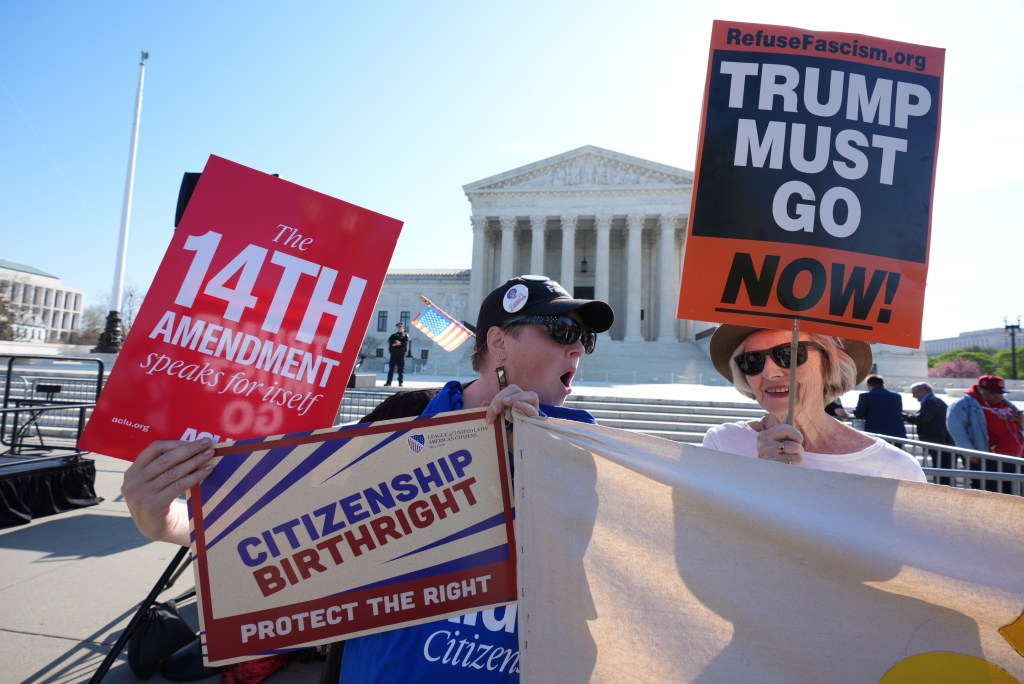


President Trump attended in person Wednesday as a skeptical-seeming Supreme Court heard oral arguments over his controversial effort to end birthright citizenship for all children born in the United States.
With Trump making a quickie historic appearance in the front row of the public gallery, the conservative justices weighed the White House’s effort to refuse citizenship to any child whose parents are not U.S. citizens or permanent residents, a move that would reverse more than a century of unbroken legal precedent.
The justices, including members of the conservative majority, sounded very skeptical about Trump’s argument.
Chief Justice John Roberts questioned Trump’s dramatic expansion of the traditional view that the only exceptions to the birthright citizenship rule were the children of foreign soldiers or diplomats.
“You expand it to the whole class of illegal aliens here in the country,” Roberts told Solicitor General John Sauer, who argued the White House’s case. “I’m not quite sure how you can get to that big group from such tiny and sort of idiosyncratic examples.”
Even Justice Brett Kavanaugh, usually a Trump loyalist, brushed off Sauer’s claim that British common law bolsters Trump’s argument, “I don’t see the relevance.”
Liberal justices made no effort to sugarcoat their disdain.
“The president is violating not just one, but four established Supreme Court precedents,” Justice Sonia Sotomayor told Sauer. “And you are claiming that both the Supreme Court and no lower court can stop an executive, universally, from violating those holdings.”
Trump left and returned to the White House after Sauer handed over questioning to a lawyer representing the plaintiffs suing to overturn his order.
“We are the only Country in the World STUPID enough to allow “Birthright” Citizenship!” Trump later wrote on his social media site, although about 30 nations grant citizenship to anyone born there without conditions.
A ruling is expected by early summer.
Trump’s order, if upheld, would practically upend the near-unanimous interpretation of the Constitution’s 14th Amendment, ratified in 1868, and a federal law passed in 1940, both of which confer citizenship on everyone born on American soil, with narrow exceptions for the children of foreign diplomats and those born to a foreign occupying force.
It would also plunge millions of Americans into uncertainty about their very identity with potentially momentous political, cultural and economic consequences.
The very words of the 14th Amendment seem to leave little room for debate: “All persons born or naturalized in the United States, and subject to the jurisdiction thereof, are citizens of the United States and of the state wherein they reside,” it reads.

The birthright citizenship order, which Trump signed the first day of his second term, is part of his broad crackdown on immigration.
He says granting citizenship to anyone born on American soil acts as an improper magnet for foreigners to come to the U.S. with the intention to have American citizen children.
“Birthright Citizenship has to do with the babies of slaves, not Chinese Billionaires who have 56 kids, all of whom “become” American Citizens. One of the many Great Scams of our time!” Trump wrote Wednesday on his social media site.
He earlier warned the justices to rule in his favor, noting that, “Dumb Judges and Justices will not a great Country make!”
Critics note that Trump and his allies could seek to pass a new constitutional amendment tweaking the edict to restrict citizenship anyway they want. But such a move would require popular consensus behind his stance, while polls say Americans mostly support the status quo.

The Trump administration asserts that children of noncitizens are not “subject to the jurisdiction” of the government and therefore are not entitled to citizenship, even though they can be arrested, imprisoned and compelled to pay taxes.
The court should use the case to set straight “long-enduring misconceptions about the Constitution’s meaning,” Sauer wrote in a filing.
No court has so far accepted that argument, and lawyers for pregnant women whose children would be affected by the order say the Supreme Court, which is dominated by six conservative justices including three appointed by Trump, should not be the first to do so.
More than 250,000 children born in the U.S. each year would be affected by the executive order, according to research by the Migration Policy Institute and Pennsylvania State University’s Population Research Institute.
While Trump has largely focused on illegal immigration in his rhetoric and actions, the birthright restrictions also would apply to people who are legally in the United States, including students and those who have applied for permanent residency, often referred to as a green card.
