'/%3E%3C/svg%3E)

'/%3E%3Cpath%20fill='%23b2b2b2'%20d='M241%20382q0%2016%2017%2026%2017%2011%2042%2011t42-11q16-11%2017-26V269H241'/%3E%3Cpath%20fill='%239f7e00'%20d='M241%20379q0%2014%208%2023%209%209%2021%209%2014%200%2021-9%209-9%209-23V269h-59'/%3E%3Cpath%20d='M241%20339v-70h59v110q0%2014-9%2023l-6%205v-68h-15v72q-8%200-14-4v-68zm59%2040c0%2022%2015%2032%2029%2032%2021%200%2030-18%2030-32v-40h-59'/%3E%3Cpath%20fill='%239f7e00'%20d='M266%20277v5h2v12h-3v-5h2v-5h-9v5h2v5h-4v9h3v18h-5v10h34v-10h-5v-18h3v-9h-4v-5h2v-5h-9v5h2v5h-3v-12h2v-5zm42%20101q0%2010%206%2017%206%206%2015%207%2010-1%2016-7%206-7%206-17v-29h-43'/%3E%3Ccircle%20fill='%230044ad'%20cx='329.5'%20cy='372'%20r='6'/%3E%3Cellipse%20fill='%230044ad'%20cx='300'%20cy='340'%20rx='16'%20ry='21'/%3E%3C/svg%3E)




President Trump said Monday the U.S. hasn’t started its most powerful attacks against Iran and said the war could last about four or five weeks as the conflict showed signs of spreading across the Middle East.
“We haven’t even started hitting them hard. The big wave hasn’t even happened,” Trump told CNN. “The big one is coming soon.”
“We’re knocking the crap out of them,” he added.
At a White House medal ceremony, Trump started for the first time to explain to the American people his rationale for launching the joint strike with Israel against Iran.
He didn’t rule out using U.S. ground troops, although he suggested the war was proceeding ahead of schedule.
“This was our last, best chance to strike — what we’re doing right now — and eliminate the intolerable threats posed by this sick and sinister regime,” Trump said.
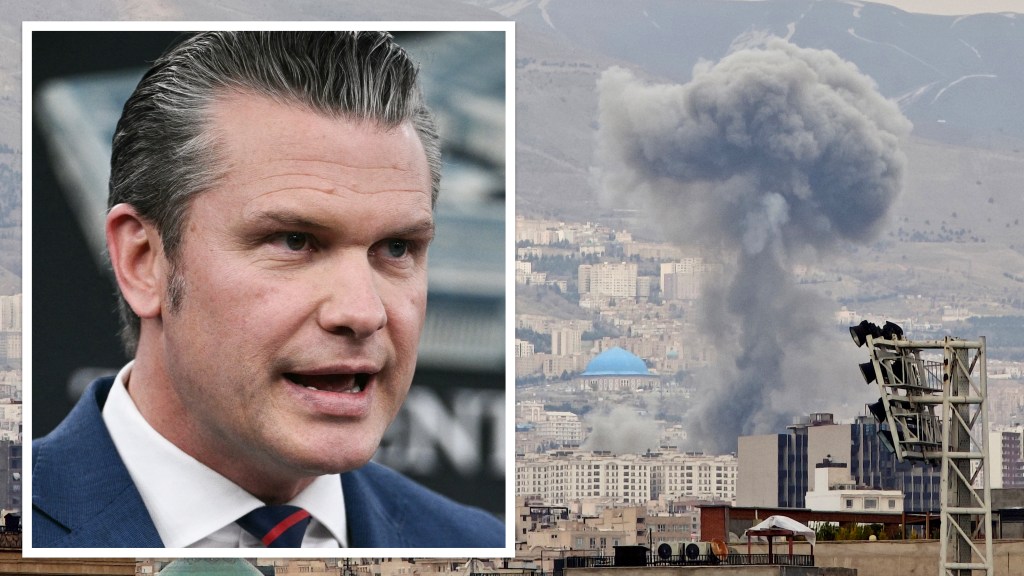
Defense Secretary Pete Hegseth also defended the U.S.-Israeli war against Iran, calling the widespread and ongoing attacks a necessary response to threats of nuclear and terror attacks
“We didn’t start this war but under President Trump we will end it,” Hegseth said. “Their war on Americans has become our retribution against their ayatollah and his death cult,” Hegseth said.
The Pentagon leader vowed the conflict would destroy Tehran’s capacity to launch missiles against Western allies and its effort to build nuclear weapon.
“We’re hitting them surgically, overwhelmingly and and unapologetically,” Hegseth said.
Gen. Dan Caine, chairman of the Joint Chiefs of Staff, said the military objective was to “prevent Iran from projecting power outside its border,” and conceded the fighting was not anywhere near ending.
“This work is just beginning,” Caine said.

Trump says the war aims to topple the Islamic Republic that has ruled Iran for nearly a half century, but he didn’t mention that objective Monday.
Hegseth cryptically denied the attack amounted to a “regime change war,” but he boasted that the “regime sure did change.”
Trump, who was expected to speak later Monday, has mostly avoided the public eye since ordering the start of attacks on Iran.
At least four American service members had been killed as of early Monday. Kuwait mistakenly shot down three American warplanes in a sign of the unpredictability of the conflict.
Iran and allied militants fired missiles at Israel, Arab states and U.S. military targets around the region Monday, while Israel and the United States pounded Iran as the conflict expanded to several fronts.

The intensity of the U.S. and Israeli attacks, the killing of Iranian Supreme Leader Ayatollah Ali Khamenei, and the lack of any apparent exit plan suggests the conflict might not end anytime soon.
The global impact of the conflict came into stark view as the new week started.
Previously safe havens in the Mideast like Dubai have seen incoming fire, stranding hundreds of thousands of airline passengers. Oil prices shot up and stock markets dipped.
Iran has long threatened, if attacked, to drag the region into total war, including targeting Israel, the Gulf Arab states and the flow of crude oil crucial for global energy markets.

The American political implications of the war remain very unclear. Although public opinion usually rallies behind a president during wartime, Trump’s failure to seek consensus about a new battle in the Middle East has left early opinion sharply divided.
Rep. Hakeem Jeffries said House Democrats would seek to force a vote on a war powers resolution, which he said is required under the Constitution.
He questioned why American service members are dying in a battle with an enemy that didn’t pose any imminent threat.
“They’re starting a war that we all know will not end well,” said Jeffries (D-Brooklyn), the House minority leader. “We still haven’t been provided any rationale for this potential endless war.”
