'/%3E%3C/svg%3E)

'/%3E%3Cpath%20fill='%23b2b2b2'%20d='M241%20382q0%2016%2017%2026%2017%2011%2042%2011t42-11q16-11%2017-26V269H241'/%3E%3Cpath%20fill='%239f7e00'%20d='M241%20379q0%2014%208%2023%209%209%2021%209%2014%200%2021-9%209-9%209-23V269h-59'/%3E%3Cpath%20d='M241%20339v-70h59v110q0%2014-9%2023l-6%205v-68h-15v72q-8%200-14-4v-68zm59%2040c0%2022%2015%2032%2029%2032%2021%200%2030-18%2030-32v-40h-59'/%3E%3Cpath%20fill='%239f7e00'%20d='M266%20277v5h2v12h-3v-5h2v-5h-9v5h2v5h-4v9h3v18h-5v10h34v-10h-5v-18h3v-9h-4v-5h2v-5h-9v5h2v5h-3v-12h2v-5zm42%20101q0%2010%206%2017%206%206%2015%207%2010-1%2016-7%206-7%206-17v-29h-43'/%3E%3Ccircle%20fill='%230044ad'%20cx='329.5'%20cy='372'%20r='6'/%3E%3Cellipse%20fill='%230044ad'%20cx='300'%20cy='340'%20rx='16'%20ry='21'/%3E%3C/svg%3E)


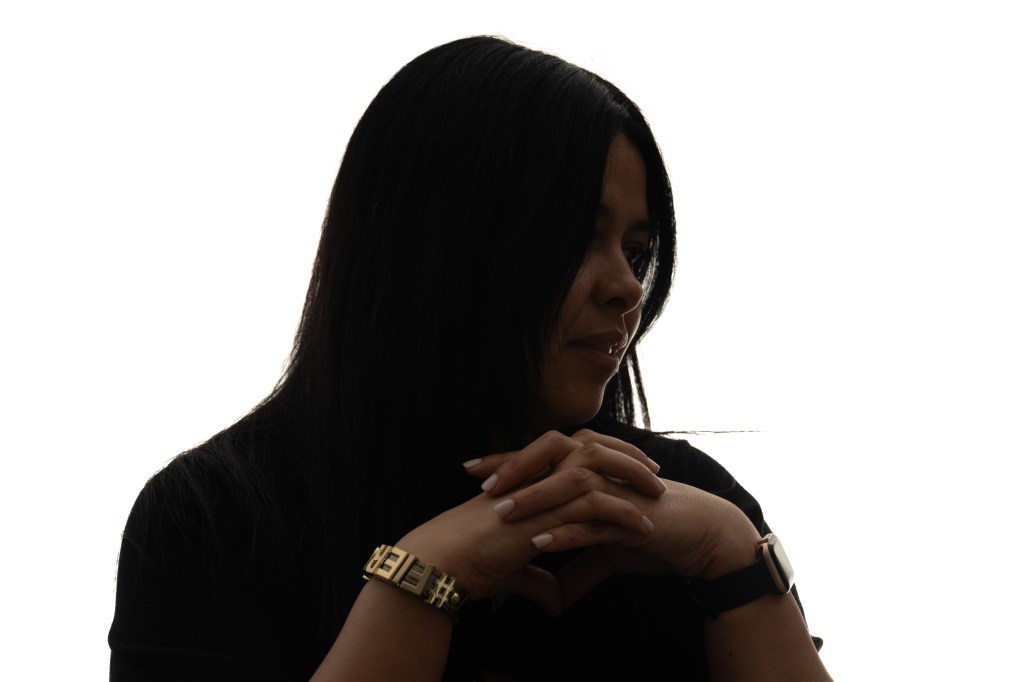


Josabeth Diaz is a Bronx mother of three who spent two decades in an abusive relationship until she had her husband prosecuted after she blacked out when he choked her in 2022.
But she knows that in the Bronx, many domestic violence cases aren’t prosecuted because victims won’t cooperate with the District Attorney’s office — even in instances where the victims called 911.
Today, her abuser is her ex-husband and Diaz is in a happy relationship with another man. And she has taken on a new volunteer role, speaking to women just like her, urging them to stand up for themselves, realize there is a better way to live and leave behind abusive partners.
“Even if I just help one person, it’s worth it,” Diaz told the Daily News. “I don’t want anyone to go through what I went through. For too long I thought what I was experiencing was normal because that’s what I grew up experiencing. It’s not normal.”
In the Bronx, domestic violence victims, an overwhelming majority of them women, often do not, for any number of reasons, cooperate with prosecutors.
According to data compiled by the NYPD’s Patrol Services Bureau, the offices of the city’s five district attorneys declined to prosecute 938 cases in the last three months of 2025 because victims failed to cooperate.
An astounding 855 of those 938 cases, or 88%, were in the Bronx. About 60% of the Bronx tally involved domestic violence cases that fell apart.
Agata DiGiovanni, head of the Bronx DA’s Domestic Violence Bureau, said that while intimate partner violence cuts across all demographics, socio-economic conditions in the borough are particularly acute.
Many women, she said, are largely or fully dependent on their abusers for financial support and fear losing that income, especially if they are raising children.
And many are immigrants from countries with a built-in distrust of police and government to begin with. Some abusers, she added, will even threaten to call immigration on them if they call for help.
”I also think that people sometimes are not even inclined to call police in the first place,” DiGiovanni said. “But when they do call police and an emergent situation is resolved then the further cooperation is not something they’re interested in doing.”

Theodore Parisienne / New York Daily News; Courtesy of family
Yesenia Hall (inset) was fatally stabbed in her Bronx apartment on Saturday, Feb. 28, 2026. (Theodore Parisienne / New York Daily News; Courtesy of family)
In one such recent case, Yesenia Hall, 42, was stabbed to death Feb. 28 and her 16-year-old son was badly wounded in a confrontation with her long-time boyfriend, police said.
When Juan Rivas, 45, was later busted and charged with murder, police and law enforcement sources revealed his history of domestic violence arrests in which he was accused of attacking Hall. The victim, sources said, had repeatedly let Rivas back into her life and did not cooperate with prosecutors.
Her family was aware of the couple’s history but said the only one responsible for her murder was Rivas.
“I would never blame my mother for her [domestic violence] situation ever,” her daughter, Jaylah Maldonado, 22, wrote on GoFundMe. “It’s difficult to go through, and she was extremely loved by her family and friends.”

Theodore Parisienne / New York Daily News
Juan Rivas, the suspect in the stabbing death of his girlfriend, Yesenia Hall, and the attempted murder of her 16-year-old son, at his arraignment in the Bronx on March 1. (Theodore Parisienne / New York Daily News)
So what to do?
DiGiovanni said prosecutors can sometimes, depending on the evidence available, go forward with a case even if the victim has stopped cooperating. When that is not possible victims are still offered services and a way out of an abusive relationship.
Nearly seven out of 10 women will be choked by an intimate partner and nearly die, according to a new public service campaign from Bronx District Attorney Darcel Clark.
The attention to strangulation is an effort to get more women to realize the dangers of being choked out, given many such victims minimize such attacks, often because there are no marks left behind.
For Diaz, such an attack was the final straw.
She met her husband, through a friend, in 2002. “It was toxic from the beginning,” she said. He was a jealous, controlling and manipulative narcissist, she said, and their relationship was fraught with anger and violence.
The first assault, getting slapped in a nightclub while they were still dating, passed without any police intervention.
“Because I grew up seeing it,” Diaz said. “The furthest back I can remember, I was 2 years old and I remember seeing my dad hitting my mother. I did see my mother fight back … But she would share stories about how my dad beat her and that gave me a fear of my father.”
Diaz’s boyfriend, she said, would always apologize, buy her gifts and promise to be better.
But things didn’t get better.
While still dating, Diaz called police for the first time and had him arrested because he put her in a chokehold after finding out she had lied and let her daughter from a previous relationship visit with an aunt and uncle he did not like.
“What did you do to him?” his mother asked Diaz.
She admitted to his mother that she had lied, blamed herself, then told the DA’s office she wouldn’t cooperate in his prosecution. The charges were then dismissed.
“I regretted it,” she said. “And he apologized.”

They married in 2007 and had a son and daughter together. But the tensions remained high.
She said that while at a holiday party with co-workers in 2011, they argued and she woke up with her face so swollen she needed to take off two days. She then explained away the bruises as the result of a dental procedure.
To this day, she doesn’t remember what happened.
She didn’t call police then and her marriage settled into a consistent pattern, with her kids harshly disciplined by her husband and always fearful of what might happen next.
The breaking point came in 2022 when she learned he was cheating on her.
She threw him out of the house but one afternoon while working from home and with the kids at school, Diaz let him back in because he wanted to talk, a decision that nearly proved fatal, she said.
Their conversation turned sour quickly, she remembered, and she slapped his hand away when he pointed his finger in her face.
“And then he just attacked me,” she said. “I tried to get him off me as much as I could. I bit him and I hit him back but I couldn’t escape his grip and he pinned me down. I couldn’t get him off me and he finally put me in a chokehold, MMA-style, from behind and I could not breathe.”
“I thought that was it for me,” she added. “My eyes just closed and I said a prayer in my head. I was like, ‘God, just take me.’”
But that didn’t happen.
Diaz came to and even though her husband choked her again and threw her to the floor, she remained conscious, grabbed her phone, ran into the bedroom, locked the door and called 911, she said.
“You’re a liar!,” he kept screaming as she tried to explain to the operator where she was, her voice so raspy from the attack it took several minutes for the 911 dispatcher to hear what she was saying.
Police arrived and her husband, by then taking a shower as if nothing had happened, was arrested, Diaz remembered.
This time, it was her brother-in-law, a retired detective, who called “to see if I would drop the charges.”
She refused, chiding him, given his profession, for even asking. Her husband, meanwhile, kept violating the order of protection issued after his arrest, showing up at her health care job and even calling Diaz as she was with the prosecutor handling his case.
He pleaded guilty to criminal obstruction of breathing and criminal contempt for violating the order of protection and was sentenced to two years behind bars, according to the DA’s office.
He’s free now but Diaz said she is confident, as a woman of faith, that she is protected and he will no longer bother her.
She said a therapist helped get her past the regret she felt, at first blaming herself for pursuing justice before realizing “I didn’t choke myself — he did this to me.’”
Physically, she’s still not completely recovered. Despite speech therapy, her vocal chords are not what they once were.
“I used to sing, karaoke, and sing in church,” she said. “But I can’t hit those high notes now — still.”
