




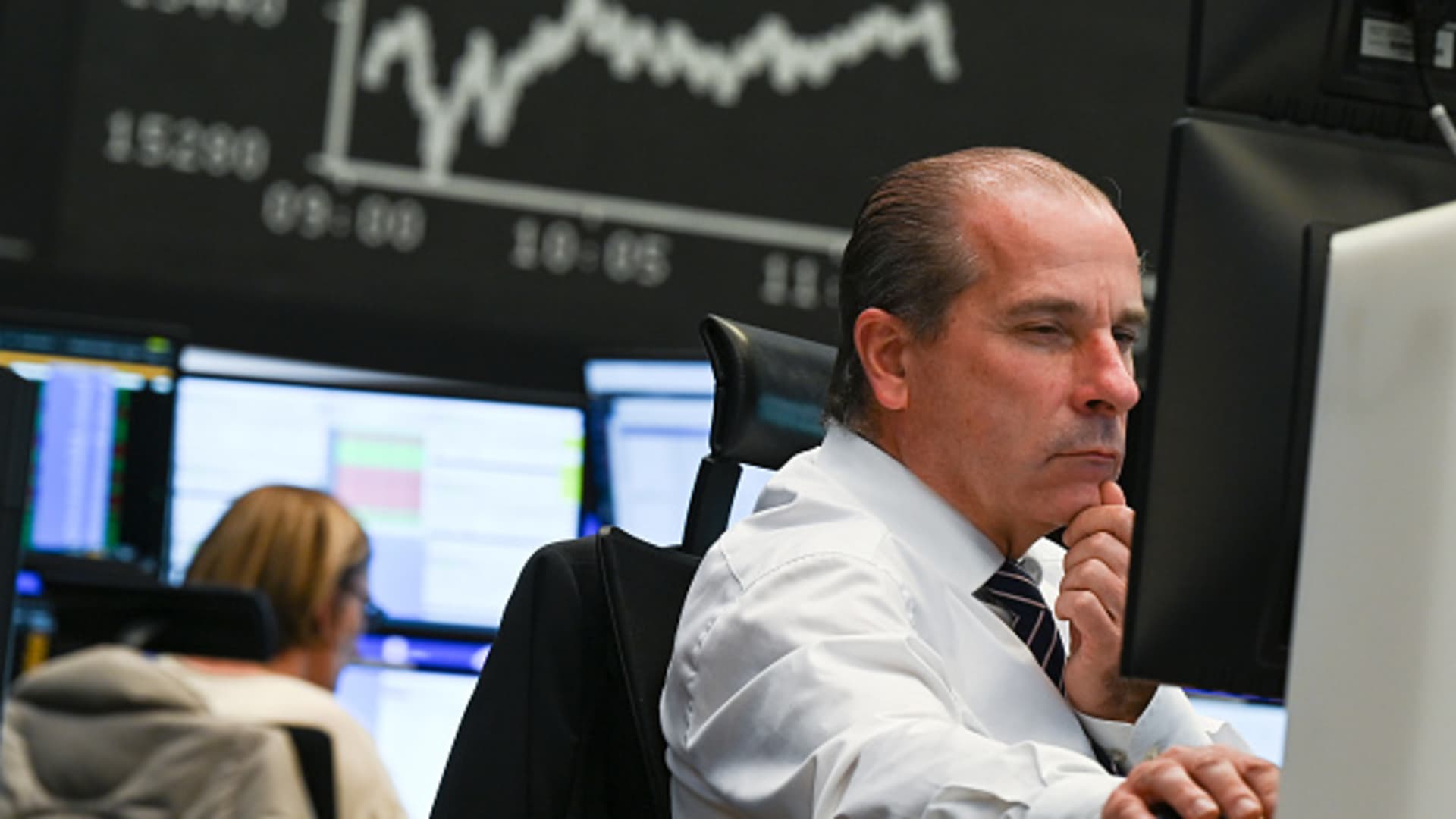


A stock trader looks at his monitors in the trading room of the Frankfurt Stock Exchange. Worries about a new coronavirus mutation in southern Africa have dealt a major blow to the German stock market.
Arne Dedert | Picture Alliance | Getty Images
LONDON — European stocks traded lower on Thursday as regional market sentiment remains downbeat and oil prices tick higher.
The pan-European Stoxx 600 was down almost 0.1% by 9:00 a.m. in London (4:00 a.m. E.T.), with most of the region’s major bourses in negative territory and sectors showing mixed performance.
Shares in cosmetics giant L’Oreal led the Stoxx 600 and are on track for their best day since November 2008 if current gains are held. L’Oreal posted its fastest quarterly growth in two years on Thursday, lifting shares by 8.7% in morning trade.
Nokia shares advanced 8.2% after the Finnish telco reported strong first quarter earnings. The group posted 4% year-on-year growth in net sales, with operating profits coming in at 281 million euros ($328.8 million), up 54% year-on-year and beating analysts’ estimates.
Justin Hotard, president and CEO of Nokia, told CNBC’s “Squawk Box Europe” Thursday that the company is tapping into the longer-term structural growth opportunity in AI, particularly in optical networks.
Meanwhile, Saab fell 4.2% after the defense giant reported first-quarter order bookings of 18.2 billion Swedish kronor, a decline of 5% from the same period the previous year.
The military hardware manufacturer said it had received fewer large orders in the three months to March, but more medium-sized orders.
Sales came in at a weaker-than-expected 19.1 billion kronor, but represented organic sales growth of 23.6%. Operating profit for the quarter jumped 32% year-on-year to 1.92 billion kronor, beating estimates compiled by LSEG.
Elsewhere, International Energy Agency executive director Fatih Birol warned the world faces the “biggest energy security threat in history.”
Speaking with CNBC’s Steve Sedgwick at this year’s CNBC CONVERGE LIVE in Singapore on Thursday, Birol warned of “difficult days” ahead for Europe’s jet fuel supplies as a result of the Iran conflict. The IEA chief said countries may need to review their energy trade partners and trade routes if the Strait of Hormuz remains closed.
International benchmark Brent crude rose almost 0.9% to $102.88 per barrel on Thursday, following media reports that the U.S. has intercepted at least three Iranian oil tankers in Asian waters, heightening uncertainty that the Middle East conflict may drag on.
Meanwhile, U.K. government borrowing fell by almost £20 billion to £132 billion in the financial year ending March 2026, according to new Office for National Statistics data. Gilt yields initially fell in response, but reversed course when fresh PMI data pointed to a sharp increase in inflationary pressures.
Sentiment was also kept in check after Germany halved its economic growth forecasts for 2026, with officials saying they now expect Europe’s largest economy to grow just 0.5% this year. For 2027, the GDP forecast was trimmed from 1.3% to 0.9%.
Germany’s Economics Ministry cited the Iran war and closure of the Strait of Hormuz as reasons for the downgrades, and said the country had seen costs for households and businesses rise. Officials projected that inflation would rise to 2.7% this year and 2.8% next year.
Japan and South Korea stocks hit record highs overnight, before Asia-Pacific markets retreated into negative territory, following the reports of Iran tanker interceptions. S&P 500 futures were little changed Wednesday night.
It’s another busy day for earnings in Europe with Roche, Nestle, SAP, Sanofi, Vinci, LSEG, Orange, Heineken, STMicroelectronics, Dassault Systemes and Renault among the companies reporting Thursday.
Data releases include flash services and manufacturing PMIs for the euro zone and U.K., and EU new car registrations.
